
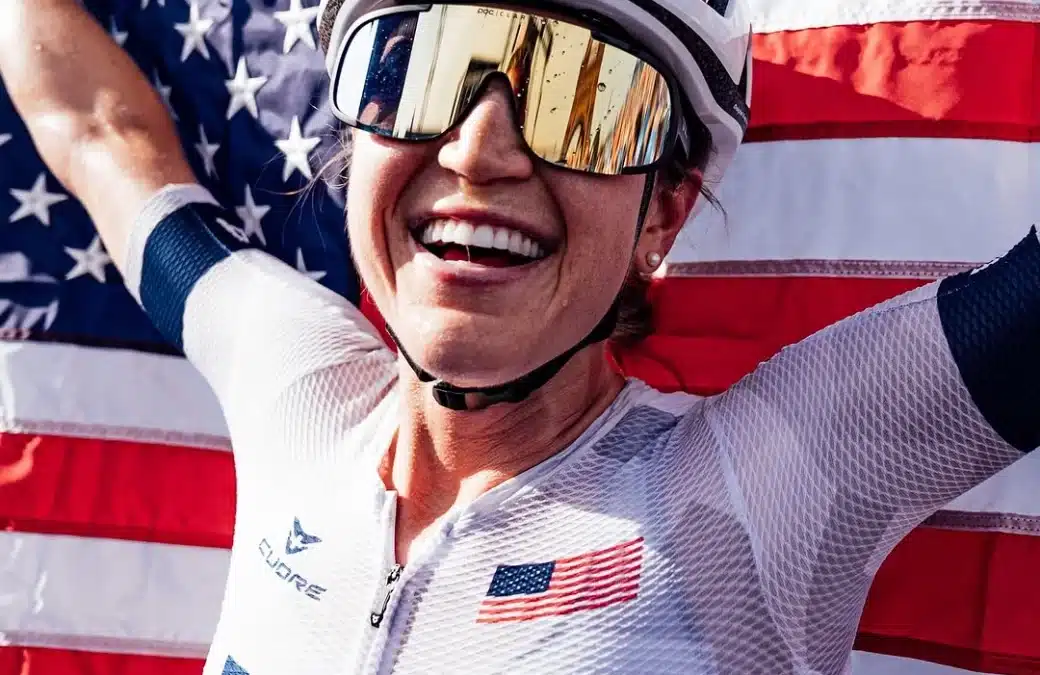
Kristen Faulkner has opened a rare window into the invisible work behind her performance. The Olympic road cycling champion has revealed that she has spent two months developing her own Artificial Intelligence (AI) tool to better understand how her body responds and transform that information into useful decisions for training and competition. Faulkner claims she just recorded her best 20-minute power output.
What’s most striking about the EF Education-Oatly runner isn’t just her use of AI, but the reason that drove her to build it. The American explains that the research she needed about her own body “didn’t exist,” especially in a field where she believes there are still very few studies focused on women, and even fewer on elite athletes. That’s why she decided to take matters into her own hands.
“I took matters into my own hands and started writing that research myself,” she stated in her LinkedIn post where she explains everything. Faulkner, double Olympic gold medalist in Paris 2024 (road race and team pursuit), explained that for almost a decade she had been accumulating biometric data without finding a truly useful way to integrate it.
Heart rate, heart rate variability, sleep, weight, power output, temperature, training load, menstrual cycle phases, blood tests, and DEXA scans were all part of a massive archive that, until now, was scattered. According to her, the problem wasn’t a lack of data, but rather that each platform only offered a piece of the complete picture.
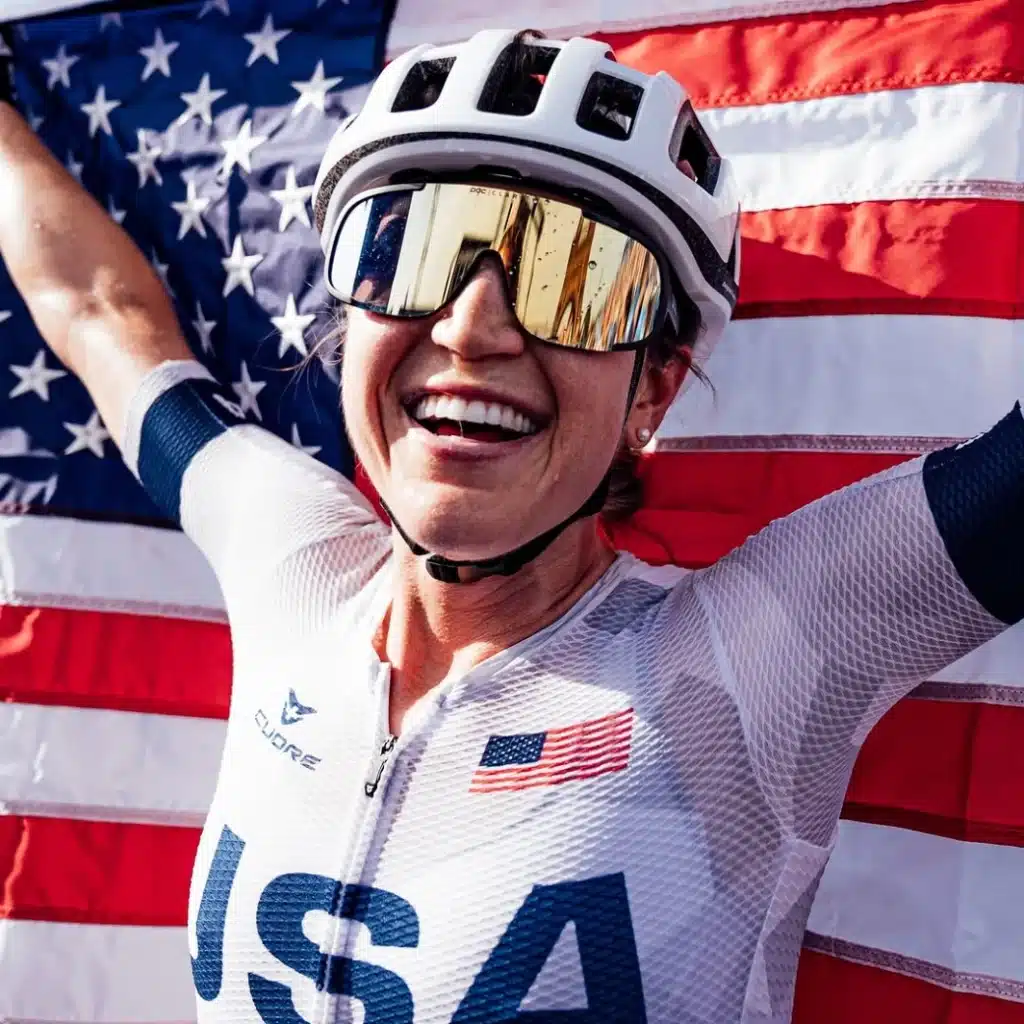
Faulkner is tired of training blindly.
From there, she decided to build her own system capable of gathering the sources she uses as an athlete and cross-referencing them with 4,400 hours of training history. Her goal wasn’t to have a prettier dashboard or another statistical summary, but to develop personalized models of her physiology. In her words, “each model is trained on my body,” “each finding is specific to my history,” and “each result is actionable, not just interesting.”
This approach, according to the American cyclist, already had a direct competitive application in her preparation for the Pan American Championships, where she won three gold medals this year. Faulkner also maintains that this same tool is what has helped her achieve her best 20-minute power output, a particularly relevant metric as it is one of the most widely used indicators for measuring a cyclist’s fitness.
The publication also helps to better understand why this project fits her profile. Faulkner mentions that she studied computer science at Harvard, worked in venture capital, and actively invests in companies linked to artificial intelligence. All of this experience has now led her to professional cycling, where she competes in the WorldTour while preparing for her major medium-term goal: defending her Olympic gold medal in Los Angeles 2028.
Her message also conveys a fundamental idea that goes beyond her own case. Faulkner is convinced that artificial intelligence can change research into women’s performance “from the ground up” and wants to be part of that process. She doesn’t see it as a technological fad, but rather as a way to fill a historical gap in the knowledge applied to high-level women’s sports.
This also aligns with how she herself explains her sporting career. Faulkner recalls that she came to cycling late and never had the advantage of extensive prior competitive experience. Her response, she says, was to compensate with analysis, study, and preparation.
Before her first European race, she even went so far as to create profiles of her rivals, study every curve of the courses, and obsessively review her data. Now, that same logic has taken her a step further with a tool she designed herself.
Source: www.brujulabike.com